
Categories
Column Food Health

Should Calories Be Printed on Food Labels? The Pros and Cons

In recent years, many countries have begun requiring restaurants and packaged foods to display calorie information. The idea is simple: give consumers more knowledge, and they’ll make healthier choices. But the impact of calorie labelling isn’t as clear-cut as it seems.

The Case for Calorie Labels: For many, calorie labels act as a quick guide in navigating food choices. Seeing numbers beside menu items or on packaging can help people compare options and understand the energy density of what they eat. It’s especially useful for those tracking intake for health, fitness, or medical reasons. Labels can encourage broader awareness of nutrition and portion sizes. Over time, they may shift social norms around what counts as a “normal” meal size, potentially helping to reduce overeating. When calories are public, food manufacturers and restaurants have more incentive to reformulate recipes—reducing portion sizes, sugar, or fat content—to appeal to health-conscious consumers.

The Case Against Calorie Labels: Calories alone don’t tell the full story. A 300-calorie salad and a 300-calorie soda are vastly different in nutritional value. Relying too much on numbers can distract from other important factors like fibre, protein, or vitamin content. For people with or recovering from eating disorders, calorie counts can be triggering and lead to obsessive behaviours. Even for the general population, constant exposure to numbers may turn eating into a source of guilt rather than nourishment. Research shows that while calorie labelling increases awareness, it doesn’t always lead to healthier choices. Convenience, taste, price, and habits often outweigh calorie information when deciding what to eat.

Finding the Middle Ground: Transparency is valuable, but so is context. Calorie labelling works best when combined with education about balanced eating and clearer messaging on nutrients. For some, it’s an empowering tool; for others, a source of stress. Ultimately, the success of calorie labelling depends on how it’s framed not as a moral scoreboard, but as one piece of information among many that support mindful, flexible eating.

Published in the Peebleshire News on 13th February 2026

Categories
Column Food Health

Understanding Food Date Labels – Part 2: Expiry Dates, Storage, and Reducing Food Waste Safely

The term expiry date is often used casually, but in many countries, it is not a legally defined food label. Instead, food regulations typically rely on use by and best before dates. Other terms, such as “display until” or “baked on,” may appear on packaging but are mainly intended for retailers rather than consumers. Understanding these distinctions helps prevent confusion and misuse. Storage plays a crucial role in how long food remains safe and edible. Date labels assume that products are stored according to the instructions on the packaging. For example, refrigerated foods kept above the recommended temperature may spoil much faster than expected. Similarly, once a product is opened, exposure to air and bacteria can shorten its lifespan. Many foods include guidance such as “consume within three days of opening,” which should always be followed even if the printed date is still valid.

Freezing is another way to extend the life of food, but timing matters. Foods should be frozen before their use by date, not after. Freezing slows bacterial growth and preserves safety, although it may affect texture and quality once thawed. Proper packaging is also important to prevent freezer burn and maintain freshness. Misunderstanding food dates is one of the leading causes of household food waste. Many people discard items as soon as a best before date passes, even though the food is still perfectly edible. Using common sense and your senses—checking for mold, unusual smells, or changes in texture—can help determine whether food is still suitable to eat.

In summary, use by dates must be respected for safety, while best before dates allow more flexibility. When combined with correct storage and thoughtful planning, this knowledge can reduce food waste while keeping meals safe. Understanding food labels empowers consumers to make choices that are healthier, more economical, and more sustainable.

Published in the Peebleshire News on 23rd January 2026

Categories
Column Food Health

Understanding Food Date Labels – “Use By” and “Best Before”

Food date labels are designed to help consumers make safe and informed decisions, yet they are often misunderstood. Many people assume all dates mean the same thing, which can lead either to unnecessary food waste or to eating food that may no longer be safe. Understanding the difference between use by and best before dates is key to handling food responsibly. Food manufacturers set date labels based on testing that considers safety, quality, and shelf life. These dates assume the food has been stored correctly and that the packaging remains unopened. If food is exposed to heat, air, or moisture, its shelf life can be significantly reduced regardless of the printed date.

A use by date is primarily about safety. It appears on highly perishable foods such as fresh meat, fish, milk, soft cheeses, and ready-to-eat meals. After this date, the food may contain harmful levels of bacteria that are not always detectable by smell or appearance. Consuming food past its use by date can increase the risk of food poisoning, especially for vulnerable groups such as pregnant women, older adults, young children, and people with weakened immune systems. Foods with a use by date should not be eaten after that date and should not be frozen once the date has passed.

A best before date, on the other hand, relates to quality rather than safety. It indicates when the product is expected to be at its best in terms of taste, texture, and appearance. This label is commonly found on dry, frozen, or canned foods such as rice, pasta, cereals, biscuits, and sauces. After the best before date, the food may lose freshness or flavour, but it is often still safe to eat if it has been stored properly and shows no signs of spoilage.
By understanding these labels, consumers can make better decisions, protect their health, and avoid throwing away food unnecessarily. Next week we focus on expiry dates, storage, and reducing food waste safely.

Published in the Peebleshire News on 16th January 2026

Categories
Column

5th Sep 2022

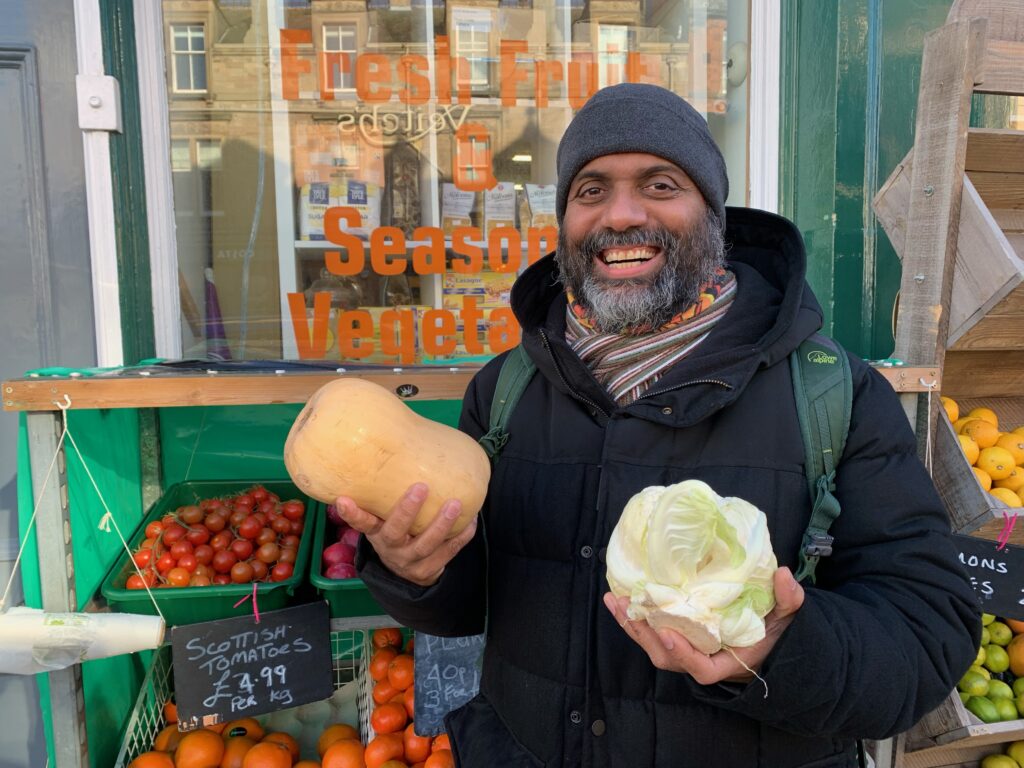
Bosco with some ingredients for cooking up a healthy meal in Peebles – teaching others in communities to do the same along with other community cooks.

This week Bosco Santimano founder and executive director of social enterprise You Can Cook, shares his thoughts in his final column on the Scottish governments plans to make it mandatory for restaurants, pubs and takeaways in Scotland to include the number of calories in our food and drinks.

In April this year, Maree Todd MSP – Minister for Public Health, Women’s Health and Sport in the Scottish Government launched a public consultation on plans to make calorie labelling on menus mandatory in restaurants, takeaways, cafes and even hospitals. This consultation fulfils a pledge made in the SNP’s 2021 Out of Home Action Plan. The Plan builds on the commitments made in the 2018 Diet and Healthy Weight Delivery Plan and recommendations made by Food Standards Scotland (FSS) to Scottish Ministers in 2019. Mandating calorie labelling at the point of choice was one potential way to support the Out of Home (OOH) sector to make a key contribution in improving the dietary health of all Scottish citizens. Pre-packed food is not within the scope of these proposals as there are already requirements to provide nutrition information for pre-packed food. Pre-packed food for direct sale (PPDS) is within the scope of these proposals. Similar legislation is already in place in England, where any food serving outlet with over 250 employees have been legally required to display calories since April 2022.

In a recent survey Beat, the UK’s eating disorder charity found 95% of Scots affected by eating disorders would be negatively impacted by calorie labelling on menus, with many worried it would increase feelings of fear and guilt.  So, what happens now? Will this add fuel to the fire? There has been an increase of people suffering from various eating disorders like anorexia or bulimia since the last decade. Young people have been facing the brunt of this epidemic as peer pressure and constant shaming on social media has led to some even resorting to suicide. This policy of the Scottish government has the potential to wreak havoc with people’s lives and exacerbate the problem even more. As an organisation, we believe focus should be on informing and educating people about the positive or negative impact about the food and drinks they consume on a daily basis. Young people should be exposed to cooking from a very young age eg. Primary and secondary schools. 

Consultant Psychiatrist in eating disorders Dr Stephen Anderson, said: “There is no good evidence that this kind of calorie labelling is effective in reducing obesity. We also hear from people with eating disorders that this would have a detrimental effect on their eating disorder. Calories are one aspect of nutritional information but on its own this figure is not particularly helpful”.

“Suggesting that people need a specific number of calories does not take into account the individual’s physiology, gender, race and activity. This could be particularly harmful for children and young people where limiting calorie and nutritional intake can have significant impacts on development. A wider public health initiative looking at social and economic determinants of obesity and improving the population’s nutrition is likely to be more beneficial than listing calorie content on menus”.

We completely agree with the above statement as this is not how food should be consumed. Cooking and eating should be a joy and is meant to be spontaneous and inspiring for all who indulge in this life sustaining activity. It does not make sense to have people removing their calculators or apps to decide what they can and cannot have depending on the total calories highlighted on the menu. This will have a negligible impact on the very issue the government is trying to address and eradicate.

Finally, I wish to take this opportunity to thank the Peeblesshire News and readers of my column for supporting my personal and organisations views and opinions over the years. Thank You.

Published in The Peeblesshire News on Friday 26th August 2022
Categories
Column

8th July 2022

This week Bosco Santimano founder and executive director of social enterprise You Can Cook, shares his thoughts on the UK governments easing of regulations around gene editing and has asked Scottish ministers to consider allowing gene-edited crops to be grown in Scotland.

Corporations and scientists in the pockets of big pharma are always on the lookout for a perfect opportunity to peddle their creations on an unsuspecting public. Brexit and the pandemic have given these capitalist opportunists a perfect situation to push for the loosening of legislation controlling the quality and safety of our food; both locally grown and imported from abroad. Westminster is hell bent on removing environmental and health safeguards that environmentalists fought for in this country for decades. So, what is happening now at Westminster? The Tory government in London has introduced a Genetic Technology (Precision Breeding) Bill which would set different rules from the EU following Brexit and has asked all devolved nations including Scotland to allow gene-edited crops to be grown. The Scottish governments environment secretary MSP Mairi McAllan dismissed the idea saying that Scotland will set its own food standards under devolution and will not accept any constraint placed on its food policies.


What is gene-editing? Gene editing basically allows scientists to change a plant or animal’s DNA. Many experts would consider it one step before GMO’s (Genetically Modified Organism) which is currently banned in Europe and the UK as a whole. Since Brexit, the UK government is hell bent on eroding all our food and environment safety laws that we as a country fought so hard to achieve over the past many decades. I have previously in my columns highlighted citizens to be vigilant against corporations, lobbyists and greedy politicians who are now convinced that the only way to grow and feed the population in the UK post-Brexit is via gene-edited or GMO foods!


Under the UK’s internal market legislation, introduced by the Tory government at Westminster, anything approved for sale in one part of the UK must be available across the whole of the UK. This legislation basically undermines “Devolution” in Scotland, Wales and Northern Ireland. We are already seeing the chaos caused by the “Northern Ireland Protocol Bill” and its hasty signing off as an election promise in their manifesto by the Tories in the 2019 general elections. MSP Mairi McAllan has written to her Westminster counterpart saying: “If the UK government is determined to press ahead with this legislation, it must take steps to ensure that its revisions to the definition of a GMO (genetically modified organism) do not force products on Scotland which do not meet standards here without the consent of the Scottish Parliament”. Simultaneously, also raising concerns about the impact of the bill on Scotland’s food exports to the European Union which currently still has a ban in place for GMO’s.


So, what can we do in Scotland to stop this mad onslaught on our food and its impact on Scottish soil and water in the coming decades if this bill is passed? Once again be informed about the technology that is being promoted, ask questions to your elected MSP/MP and try to understand the link between corporations like Monsanto, politicians and large-scale food producers. The citizens always pay the price when things go wrong, let’s make sure this does not happen to Scotland’s land, water, air and health of its population.

*Originally written & published in the Peeblesshire News and WION.